An executive had a hard conversation on her calendar for a Monday. I sent her a note beforehand with the strategy I use with executives before a meeting like that. The goal isn't to win it. The goal is to keep it honest, and that gets decided in the first two minutes, before anyone says anything real.
Most hard conversations are lost in those two minutes. People walk in braced, holding a position, already deciding who's going to give. By the time you reach the actual issue, everyone's defending instead of thinking.
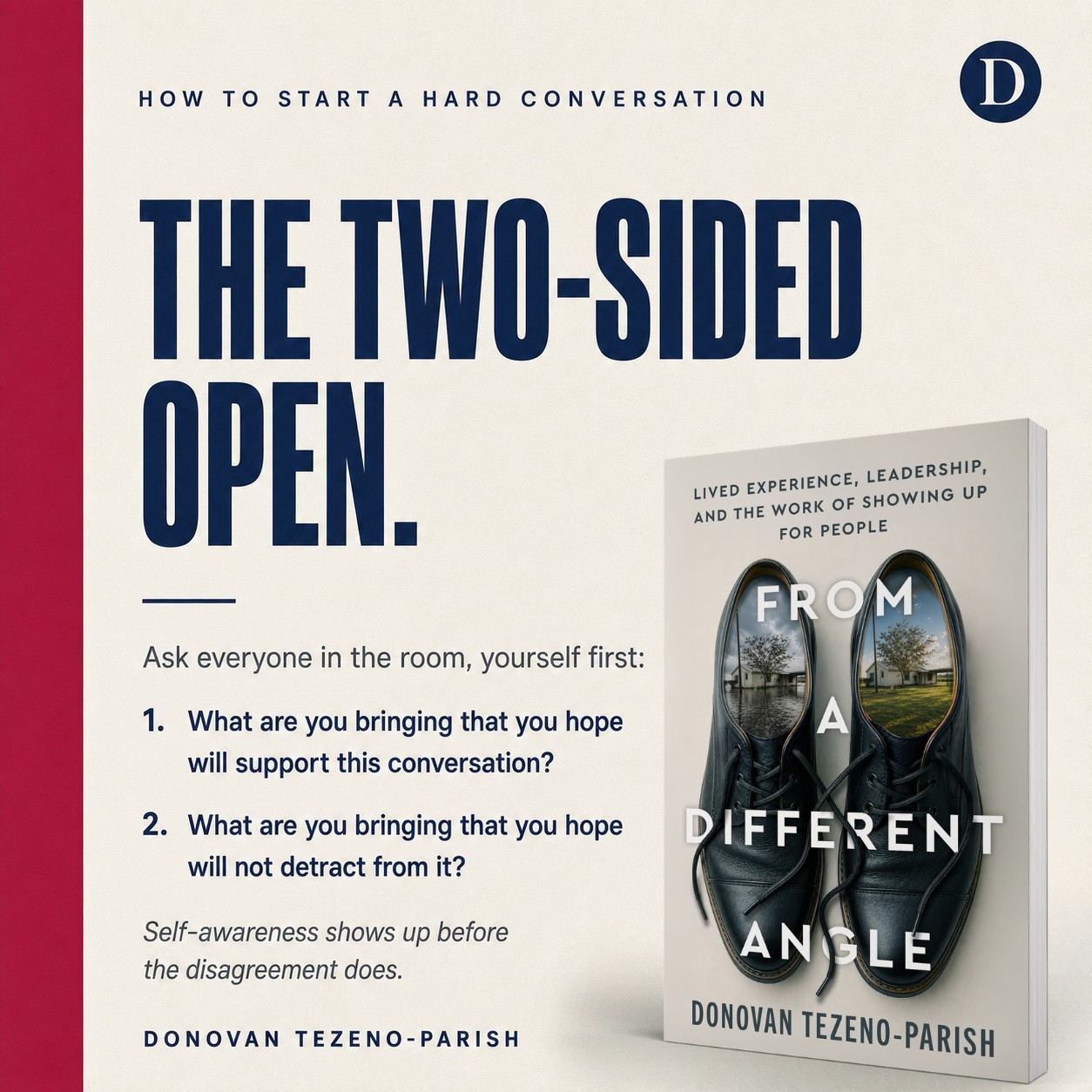
So here's the move, and it's the most useful one I know for a room like that. Before you touch the issue, say the purpose of the meeting out loud. Then tell the room you want to ask two questions to set the approach, and ask everyone, yourself first:
- What are you bringing that you hope will support this conversation?
- What are you bringing that you hope won't detract from it?
The first answer might be a commitment to open, solution-focused dialogue. The second might be an old frustration, or an assumption someone is already carrying about the other person. It doesn't matter what they name. What matters is that they named it themselves.
That's the quiet part. Nobody had to be accused of anything. You didn't tell someone they were being defensive. You gave them room to say it first, which is a completely different door. Self-awareness shows up before the disagreement does, and it changes the temperature of the room.
When the conversation drifts, and it will, you don't play referee. You go back to what the person already said and ask one more:
How does your response support or detract from what we're trying to achieve?
You're not enforcing a rule. You're asking them to measure themselves against a purpose they agreed to two minutes ago, and people hold to their own words in a way they'll never hold to yours.
Controlling a hard conversation never keeps it honest. Making everyone in the room the referee of their own behavior does. I call it the Two-Sided Open.
When the room is spent
The two questions hold most conversations. They don't hold all of them. There's a point past which more talking makes a conversation worse: the same sentence is on its third lap, voices are carrying positions instead of thoughts, and someone has started defending a version of themselves instead of examining a decision. Realignment won't fix that, because the problem is no longer drift. The room is spent.
The pause has sizes, and the smallest one is five minutes. Let's take five, grab some water, come back to it. That sounds like nothing. It works because it breaks the physical posture people are holding, and most of the defending in a hard conversation is posture. They stand, they walk, the room reorganizes itself, and the sentence someone was loading up doesn't survive the trip down the hall.
Some meetings can't be moved at all. A termination, a safety report, a deadline that expires today. There you change the question instead of the room. Say out loud that the last stretch hasn't moved anyone toward the purpose, then ask what we agree on and what one thing we still have to decide before anyone leaves. A narrower question does much of what a night's sleep does, and it runs inside a meeting that has to end on time.
When the room is genuinely spent, stop and set the return. Stopping feels like losing the room, which is why most leaders won't let themselves do it. It's how you keep it. Nobody's calendar clears by tomorrow morning, so don't promise tomorrow morning. Say that we're stopping here and picking the time before anyone leaves, then send the invite from the room at the soonest real opening. A pause with a date on it is a pause. Without one, it's an ending nobody announced, and the trust you were trying to protect pays for it.
Try it the next time you walk into one you're dreading. Set the purpose, ask the two questions, let people referee themselves, and when the room is spent, take five, narrow the question, or set the return.
From a Different Angle is on its way, and I'm building it here with you, one hard room at a time, full of tools like this one you can use the same week you read them.
-Donovan
People hold to their own words in a way they'll never hold to yours.